 Ta-Ching ChenandSoam Vasani
e4fe007838
Ta-Ching ChenandSoam Vasani
e4fe007838
Adds support for message queue triggers based on the NATS-Streaming message queue.

This lets the user map a queue topic to a function, and optionally send the function's response into another queue topic.

The message queue trigger manager is designed to be message queue independent, so we should be able add support for more queues by adding implementations for the relatively simple mqtrigger.MessageQueue interface.
144 lines
4.8 KiB
Markdown
144 lines
4.8 KiB
Markdown
|
|
A high level view of the internals of Fission.
|
|
|
|
How it works
|
|
============
|
|
|
|
Fission is a FaaS -- users create functions (source level), register
|
|
them with fission using a CLI, and associate functions with triggers.
|
|
|
|
Fission wraps those functions into a service, and runs them on
|
|
Kubernetes on demand.
|
|
|
|
Here's an overview of the services that make up fission.
|
|
|
|
Components
|
|
==========
|
|
|
|
Language-neutral components:
|
|
|
|
* controller
|
|
* poolmgr
|
|
* router
|
|
* kubewatcher
|
|
|
|
Language-specific components:
|
|
|
|
* Environment container
|
|
|
|
|
|
Controller
|
|
----------
|
|
|
|
The controller contains CRUD APIs for functions, http triggers,
|
|
environments, Kubernetes event watches. This is the component that
|
|
the client talks to.
|
|
|
|
This is the only stateful component. It needs to be configured with a
|
|
URL to an etcd cluster and a path to a persistent volume. The volume
|
|
is used to store the functions' source code. Etcd is used as the DB.
|
|
|
|
[Work to extend to other storage backends is planned, see issue #83.]
|
|
|
|
Pool Manager
|
|
------------
|
|
|
|
Poolmgr manages pools of generic containers and function containers.
|
|
|
|
It has a simple API; both these endpoints are called by the router.
|
|
|
|
* GetFunctionService takes function metadata and returns the address
|
|
of a service.
|
|
|
|
* TapService lets poolmgr know a service is being used; if it's not
|
|
called for a few minutes the pod(s) backing the service are killed.
|
|
|
|
Poolmgr watches the controller API and eagerly creates generic pools
|
|
for environments. It uses Kubernetes deployments to do that. The
|
|
environment container runs in a pod with the 'fetcher' container.
|
|
Fetcher is a very simple utility that downloads a URL sent to it and
|
|
saves it at a configured location.
|
|
|
|
GetFunctionService "specializes" a pod. The implementation chooses a
|
|
pod from the pool, relabels it to "orphan" the pod from the
|
|
deployment, invokes fetcher to copy the function into the pod, and
|
|
hits the the specialize endpoint on the environment container. This
|
|
causes the function to be loaded. The pod is now specific to that
|
|
function.
|
|
|
|
This function pod is cached; it's cleaned up if it's unused for a few
|
|
minutes.
|
|
|
|
Router
|
|
------
|
|
|
|
The router forwards HTTP requests to function pods. If there's no
|
|
running service for a function, it requests one from poolmgr, while
|
|
holding on to the request; when the function's service is ready it
|
|
forwards the request.
|
|
|
|
The router is stateless and can be scaled up if needed, according to
|
|
load.
|
|
|
|
Kubewatcher
|
|
-----------
|
|
|
|
Kubewatcher watches the Kubernetes API and invokes functions
|
|
associated with watches, sending the watch event to the function.
|
|
|
|
The controller keeps track of user's requested watches and associated
|
|
functions. Kubewatcher watches the API based on these requests; when
|
|
a watch event occurs, it serializes the object and calls the function
|
|
via the router.
|
|
|
|
While a few simple retries are done, there isn't yet a reliable
|
|
message bus between Kubewatcher and the function. Work for this is
|
|
tracked in issue #64.
|
|
|
|
Message Queue Trigger
|
|
---------------------
|
|
|
|
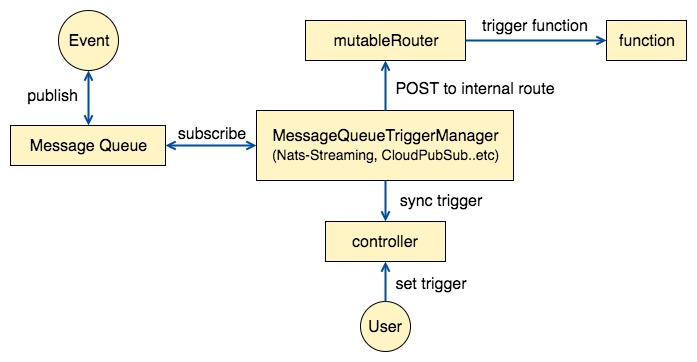
A message queue trigger binds a message queue topic to a function:
|
|
events from that topic cause the function to be invoked with the
|
|
message as the body of the request. The trigger may also contain a
|
|
response topic: if specified, the function's output is sent to this
|
|
response.
|
|
|
|
Here's a diagram of the components:
|
|
|
|
|
|
|
|
Environment Container
|
|
---------------------
|
|
|
|
Environment containers run user-defined functions. Environment
|
|
containers are language specific. They must contain an HTTP server
|
|
and a loader for functions.
|
|
|
|
Poolmgr deploys the environment container into a pod with fetcher
|
|
(fetcher is a simple utility that can fetch an HTTP url to a file at a
|
|
configured location). This pod forms a "generic pod", because it can
|
|
be loaded with any function.
|
|
|
|
When poolmgr needs to create a service for a function, it calls
|
|
fetcher to fetch the function. Fetcher downloads the function into a
|
|
volume shared between fetcher and this environment container. Poolmgr
|
|
then requests the container to load the function.
|
|
|
|
Logger
|
|
------
|
|
|
|
Logger helps to forward function logs to centralized db service for log
|
|
persistence. Currently only influxdb is supported to store logs.
|
|
Following is a diagram describe how log service works:
|
|
|
|

|
|
|
|
1. Pool manager choose a pod from pool to execute user function
|
|
2. Pool manager makes a HTTP POST to logger helper, once helper receives
|
|
the request it creates a symlink to container log for fluentd.
|
|
3. Fluentd reads log from symlink and pipes to influxdb
|
|
4. `fission function logs ...` retrieve event logs from influxdb with
|
|
optional log filter
|
|
5. Pool manager removes function pod from pool
|
|
6. Pool manager asks logger helper to stop piping logs, logger removes symlink. |